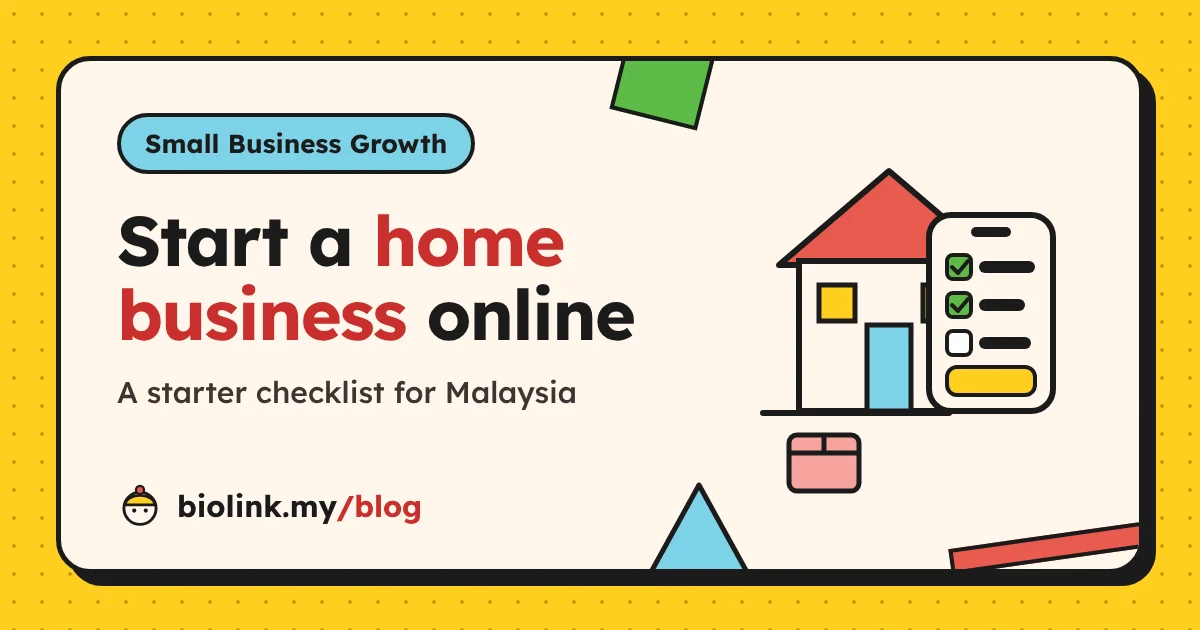
How to Start a Home Business Online in Malaysia: A Starter Checklist
Thinking of selling from home? This step-by-step checklist takes you from idea to first customers: testing demand, pricing, registration basics, getting paid, delivery and a simple online shopfront.

By Khairul Azahar Sharriffuddin · Published
Key takeaways
- To start a home business online in Malaysia, test demand with a small batch or pre-orders before you spend on stock, equipment or branding.
- Price from your real costs, including packaging, delivery and your time, then add a margin. Underpricing is the most common reason home businesses stall.
- Registration, tax and licences depend on what you sell and where. Check SSM, HASiL and your local council directly; this guide is general information, not legal or tax advice.
- Get paid with methods you control, such as a DuitNow QR from your bank, bank transfer or your own payment links. biolink.my never handles your money.
- Your first customers usually come from people who already know you. Make it easy for them to order, pay and share.
In this guide
Selling from your kitchen table, spare room or phone is one of the most common ways people start a business in Malaysia. You do not need a shop, a website or a big budget. You do need a clear plan, so you spend your first ringgit and your first weekends on things that matter. This checklist shows you how to start a home business online in Malaysia step by step: choosing an idea, testing it, pricing it, the registration basics, getting paid, delivery and finding your first customers.
Important: This guide is general information, not legal, tax or financial advice. Rules on registration, tax and licences can change and depend on what you sell and where you live. Always check the official sources linked below, or ask a qualified professional.
What a home business online looks like
A home business online usually means three things working together:
- You make, source or deliver something from home, such as food, products or a service.
- You find customers on social media and messaging apps, mostly TikTok, Instagram, Facebook and WhatsApp.
- You take orders and payments yourself, often through WhatsApp, bank transfer or a QR code, and deliver by courier, on-demand delivery or pickup.
That is why most home businesses do not need a full website to start. A phone-first page with your products, prices and an order button can do the job. Our guide to selling on social media without a website explains that approach in detail.
Step 1: Choose an idea you can deliver from home
The best first idea is not the most exciting one. It is the one you can deliver well, again and again, with the time, space and money you have now.
| Idea type | Examples | Start-up needs | Watch out for |
|---|---|---|---|
| Food | Cookies, frozen food, meal boxes | Kitchen, packaging | Hygiene rules, shelf life |
| Handmade | Jewellery, candles, crochet | Materials, tools | Time per piece |
| Curated or resale | Pre-loved fashion, imported items | Stock, storage | Cash tied up in stock |
| Digital | Templates, design, editing | Laptop, software | Standing out |
| Services | Tutoring, tailoring, makeup | Your skills, a schedule | Your hours are the limit |
Ask yourself four questions before you choose:
- Can I make or deliver ten of these in a week without letting family or work down?
- Can I explain it in one sentence and show it in a 15-second video?
- Who exactly would buy it, and where do they already spend time online?
- Do I need special permission to sell it? Food, cosmetics, health products and anything regulated need extra checks.
Step 2: Test demand before you spend
Many home businesses lose money by buying stock, equipment or branding before anyone has ordered. Test first, then invest.
- Make a small batch and offer it to friends, colleagues and neighbours at the real price, not free.
- Take pre-orders with a clear cut-off date. If nobody orders, you have lost nothing but a post.
- Post the product before it exists in bulk and see what people ask in the comments.
- Ask for honest feedback on taste, quality, price and packaging, and write it down.
A test is successful when people who are not your family pay for it and some of them come back. Our 30-day content plan gives you a month of posts you can use while you test.
Tip: Keep the first menu or catalogue small. Three to five products you do well are easier to make, photograph and sell than twenty you are still figuring out.
Step 3: Price so you actually make money
Home sellers often price by looking at others and going a little cheaper. That can leave you working hard for almost nothing. Start with your real costs instead.
| Cost item | Example per unit |
|---|---|
| Ingredients or materials | RM6.00 |
| Packaging and labels | RM1.50 |
| Your time (30 min at RM15 an hour) | RM7.50 |
| Share of gas, electricity and equipment | RM1.00 |
| Payment or platform fees, if any | RM0.50 |
| Total cost | RM16.50 |
| Price with a margin for growth | RM22.00 |
Some pricing habits that help:
- Pay yourself in the calculation, even if you do not take the money out yet.
- Decide who pays for delivery and show it clearly, so the price is not a surprise at checkout.
- Round prices sensibly and use bundles (a box of 6, a set of 3) to raise the order size.
- Show prices on your page. "PM for price" makes many buyers scroll away.
Step 4: Registration, tax and the rules, in general terms
This is the part many people skip and later worry about. You do not need to become an expert, but you should know which official bodies to check with. The points below were correct to the best of our knowledge at the time of writing; confirm them on the official websites.
Registering your business with SSM
In Malaysia, sole proprietorships and partnerships are registered with the Companies Commission of Malaysia (SSM). SSM offers online registration through EzBiz Online. At the time of writing, SSM’s EzBiz Online page says:
- The owner must be a Malaysian citizen or permanent resident and 18 or older.
- New registration costs RM30 a year for a personal name and RM60 a year for a trade name, plus RM5 a year per branch.
- Renewal is done online, and every owner or partner must register and be verified as an EzBiz user.
Whether and when your particular business must register is a legal question. If you are unsure, ask SSM directly. Many sellers register early anyway, because a registration can make it easier to open a business bank account and sign up for some payment services.
Income tax on business income
Business income is generally taxable. HASiL (the Inland Revenue Board, also known as LHDN) explains on its income reporting page that individuals with business income file Form B rather than Form BE. Filing a return does not automatically mean you owe tax: that depends on your income, allowable expenses and reliefs.
What you can do from day one:
- Keep every receipt for materials, packaging, delivery and equipment.
- Record every sale, even small ones paid in cash.
- Keep business and personal money apart as early as you can.
- Ask a tax agent when your income grows or you are unsure what counts as an expense.
Licences, food and other rules
Some businesses need more than a registration:
- Food: hygiene and food handling rules apply, and local councils may have their own licensing requirements. Start with your local council and the Ministry of Health’s Food Safety and Quality Division.
- Cosmetics, supplements and health products: these are regulated and may need approval before sale. Check with the relevant authority before you sell.
- Online selling in general: Malaysia has consumer protection rules for online trade, which expect sellers to be clear about who they are, what they sell, the full price and how delivery works. Being transparent on your page is good practice either way.
Customer data and privacy
When you collect names, phone numbers and addresses, treat them carefully. Malaysia’s Personal Data Protection Act applies to personal data used in commercial transactions; the Personal Data Protection Department explains the principles. In practice: collect only what you need, say why, keep it safe and do not add people to broadcast lists without their agreement.
Step 5: Decide how you get paid
Pick one or two payment methods your customers already use and make them easy to find. You do not need a payment gateway on day one.
| Method | How it works | Good for | Keep in mind |
|---|---|---|---|
| Bank transfer | Customer transfers to your account | Most orders | Check the payment arrived before sending |
| DuitNow QR | Customer scans your QR in their banking or e-wallet app | Pickups, quick orders | Get it from your bank or e-wallet provider |
| Your own payment link | A link from a gateway you sign up for | Card payments, pre-orders | Gateway fees and sign-up rules |
| Cash on pickup | Paid when collected | Neighbours, regulars | Risk of no-shows |
PayNet, which runs DuitNow, explains that merchants get a DuitNow QR through a participating bank or e-wallet provider, and that fees vary by provider.
On biolink.my you can show your QR code in a tip jar block and add your own payment links, for example from ToyyibPay, Billplz or Stripe Payment Links. biolink.my never handles your money: payments go straight from your customer to you.
Step 6: Plan delivery and pickup
Delivery is where many first orders go wrong. Decide your rules before the first order arrives and write them on your page.
- Choose your options: self-pickup, your own delivery nearby, on-demand delivery apps for same-day orders, or a courier for other states.
- Set a delivery area and days. "Pickup in Shah Alam, courier to Peninsular Malaysia, posted every Tuesday and Friday" is clear.
- Package for the trip. Test-send one parcel to a friend in another town before you promise national delivery.
- Say who pays for delivery and when it is added.
- Share a tracking number or a photo when the order goes out. It saves you a lot of "where is my parcel?" messages.
Step 7: Build your online shopfront in an afternoon
You need two things: a place to talk to customers and a page that shows what you sell.
Set up WhatsApp Business
The free WhatsApp Business app gives you a business profile, a catalogue, quick replies and labels for orders. Our guide on selling on WhatsApp from Instagram and TikTok walks through the setup.
Make one link-in-bio page your shop
Social profiles give you one link, so make it count. A free biolink.my page can hold:
- A WhatsApp order block with your products, photos and prices. Customers pick items and send you the complete order in one tap.
- Your payment options: a QR code in a tip jar block and your own payment links.
- An action bar with quick buttons such as WhatsApp, Call, Order and Share at the bottom of the screen.
- A countdown for pre-order cut-offs and festive season orders.
- A lead form so interested people can leave their details.
- Text blocks for delivery areas, pickup times and your policies.
Our step-by-step setup guide shows every screen, and you can pick a look on the templates page.
Step 8: Find your first customers
Your first customers almost always come from people who already know you, or know someone who does. That is normal, not a failure.
- Tell your own circle first: family, friends, colleagues, neighbours and your WhatsApp contacts, with one clear message and your page link.
- Join local community groups where selling is allowed, and follow their rules.
- Post short videos of the product being made, packed and enjoyed. Keep the link in your profile bio and say what is there.
- Offer a reason to order now, such as a launch batch or a pre-order cut-off.
- Ask happy customers for a photo or a short review, with their permission to share it.
- Make reordering easy: a thank-you message with your page link brings people back. Our guide to getting repeat customers shows how.
For more ideas once you have your first orders, see our online marketing tips for Malaysian sellers.
Step 9: Simple systems for your first month
You do not need software. You need a few habits that stop orders slipping through the cracks.
- An order log: one spreadsheet or notebook with date, customer, items, amount, paid (yes/no) and delivered (yes/no).
- A stock list, updated every evening.
- Saved replies for prices, delivery and payment details.
- A weekly review: what sold, what did not, which posts brought orders. On biolink.my, your analytics show page views, clicks, traffic sources, countries and devices.
- A business account or at least a separate savings pocket for business money.
Your home business starter checklist
| Step | Task | Done when |
|---|---|---|
| 1 | Choose one idea | You can explain it in one sentence |
| 2 | Test with a small batch or pre-orders | Non-family customers have paid |
| 3 | Price from real costs | Every product has a margin |
| 4 | Check SSM, tax and licence rules | You know what applies to you |
| 5 | Set up payments | A customer can pay in one step |
| 6 | Decide delivery rules | Areas, days and fees are written down |
| 7 | Build your page and WhatsApp Business | Your bio link opens your shop |
| 8 | Tell your first 50 contacts | Your first orders are in |
| 9 | Start an order log | Every order is tracked |
Conclusion
To start a home business online in Malaysia, you do not need everything at once. Pick an idea you can deliver, test it with real paying customers, price it properly, check the official rules with SSM, HASiL and your local council, and make ordering and paying as easy as one tap. Then keep showing up with simple, honest content.
biolink.my is free for everyone, with no paid tiers and no fees on your sales. It is supported by one small, clearly labelled "Sponsored" card at the bottom of public pages, never between your links or products.
Frequently asked questions
Do I need to register with SSM to sell from home?
Many home businesses in Malaysia are expected to register, and registering also helps with things like a business bank account and some payment services. The rules have exceptions and details that can change, so check the Companies Commission of Malaysia (SSM) directly, for example its EzBiz Online page, or ask SSM before you decide.
How much does it cost to register a business with SSM online?
At the time of writing, SSM’s EzBiz Online page lists RM30 a year for a business registered under your own name and RM60 a year for a trade name, plus RM5 a year for each branch. Fees can change, so check the official page before you pay.
Do I pay income tax on a small home business?
Business income is generally taxable in Malaysia, and HASiL (LHDN) explains that individuals with business income use Form B. Whether you end up owing tax depends on your total income, expenses and reliefs. Keep records from day one and check HASiL’s guidance or ask a tax agent.
Can I sell food from home in Malaysia?
Many people do, but food has extra rules around hygiene, food handling and sometimes premises or council licences, and they can differ by state and local authority. Check with your local council and the Ministry of Health’s Food Safety and Quality Division before you start taking orders.
What is the easiest way to accept payment for a home business?
Bank transfer and a DuitNow QR are common and simple. PayNet explains that merchants get a DuitNow QR through a participating bank or e-wallet provider, and fees vary by provider. On biolink.my you can show your QR in a tip jar block and add your own payment links.
What home business ideas work well online in Malaysia?
Ideas you can make or deliver reliably from home and explain in a short video tend to work best: baked goods and frozen food, handmade products, pre-loved or curated fashion, tutoring, design, alterations, and services booked over WhatsApp. Choose based on your skills, time and the space you have.